[[Файл:Собор Владимирской иконы Божией Матери (Санкт-Петербург).jpg|мини|справа||alt=Собор Владимирской иконы Божией Матери (Санкт-Петербург)]]
[[Файл:Собор Владимирской иконы Божией Матери (Санкт-Петербург)9.jpg|400px|мини|справа||alt=Собор Владимирской иконы Божией Матери (Санкт-Петербург)]]
'''Собор Владимирской иконы Божией Матери''' [[Аннотация::построен в 1761-1769 годах, расположен в самом центре Петербурга.]] От Владимирской церкви происходят наименования Владимирского проспекта и Владимирской площади. Храм принадлежит Санкт-Петербургской епархии Русской Православной Церкви, входит в Центральный благочиннический округ.
'''Собор Владимирской иконы Божией Матери''' [[Аннотация::построен в 1761-1769 годах, расположен в самом центре Петербурга.]] От Владимирской церкви происходят наименования Владимирского проспекта и Владимирской площади. Храм принадлежит Санкт-Петербургской епархии Русской Православной Церкви, входит в Центральный благочиннический округ.
{{Погода|id= 2}}
{{Погода|id= 2}}
Строка 39:
Строка 39:
В августе 1989 года после 60-летнего отчуждения и запустения Собор Владимирской иконы Божией Матери решением Ленгорисполкома был передан ленинградской Епархии. Способствовали возвращению собора и видные светские петербуржцы – учёный, историк и писатель, русский патриот Л. Н. Гумилев и почетный гражданин Санкт-Петербурга Д. С. Лихачев, один из предков которого был старостой храма.
В августе 1989 года после 60-летнего отчуждения и запустения Собор Владимирской иконы Божией Матери решением Ленгорисполкома был передан ленинградской Епархии. Способствовали возвращению собора и видные светские петербуржцы – учёный, историк и писатель, русский патриот Л. Н. Гумилев и почетный гражданин Санкт-Петербурга Д. С. Лихачев, один из предков которого был старостой храма.
7 апреля 1990 года, на Благовещение, было совершено освящение храма Митрополитом Ленинградским и Новгородским Алексием (Ридигером), который стал настоятелем Собора Владимирской иконы Божией Матери. Тогда же ключарем храма был назначен митрофорный протоиерей Владимир Фоменко. Продолжая установленную традицию, последующими настоятелями храма были митрополит Санкт-Петербургский и Ладожский Иоанн (Снычев), а с 1996 года по настоящее настоятелем Собора является Его Высокопреосвященство митрополит Владимир (Котляров). Приходской штат духовенства состоит из пяти священников и четырех диаконов.
== Современное состояние ==
С августа 1991 года и по сегодня председателем Приходского совета является Иван Сергеевич Раевский.
В настоящее время ведутся проектные и реставрационные работы по воссозданию иконостасов верхнего и нижнего храмов, а также украшению собора предметами церковного декоративно-прикладного искусства.
В настоящее время ведутся проектные и реставрационные работы по воссозданию иконостасов верхнего и нижнего храмов, а также украшению собора предметами церковного декоративно-прикладного искусства.
== The Church of the Vladimir Icon of the Mother of God in St. Petersburg ==
[https://yandex.ru/maps/org/sobor_vladimirskoy_ikony_bozhiyey_materi/1040875383/?ll=30.348459%2C59.928181&panorama%5Bdirection%5D=86.869752%2C15.499426&panorama%5Bfull%5D=true&panorama%5Bpoint%5D=30.347454%2C59.928179&panorama%5Bspan%5D=68.706545%2C60.000000&z=15 '''Совершить виртуальную экскурсию вокруг храма''']
Walking along St. Petersburg's Vladimirsky Prospect or Kolokolnaya Street, one notices a tall and slender bell tower. It is the Church of the Vladimir Icon of the Mother of God. Its golden domes rise majestically above the surrounding landscape. Their warm glow in the blue sky is a beautiful sight. Few locals and tourists could resist the urge to take a picture as a highlight of their visit.
Completed in the 18th century, this church is one of the oldest in the city. It has two stories, with the lower church dedicated to St. John Damascene and the upper to the Vladimir Icon. Its alternative name is the Vladimirskaya Church, not to be confused with Prince Vladimir Cathedral.
The design of this five-domed sanctuary straddles the line between Baroque and Classicism, with some predominance of the former. Baroque architecture is a style that emerged in Italy in the late 16th century. It spread widely across America, Europe and Russia in the 17th and 18th centuries. Portuguese sailors first used the word "Baroque" to refer to pearls of irregular shape. In Italian, the term came to describe an extravagant style with excessive decor and complication. Erratic forms, extravagance, abundant ornamentation and complexity are some of the keywords for Baroque. Its most typical features include:
* Stark deviation from the classical architectural order: in Baroque architecture, the parts of the order (base, entablature, capital) are disproportionate and superimposed, juxtaposing harmony with asymmetry and unity with discontinuity;
* An illusion of distorted space: one common technique in the design of facades was to bring forward some elements of the front wall and move back the others. The alternation of protrusions and recesses made the building seem even grander. Elements such as bay windows, towers, semi-columns and balconies emphasised the idea of volume and movement.
* A taste for the grandiose, as seen in the details such as grand staircases, raised arcs, massive columns or sculptures.
In a nutshell, baroque is a byword for exuberance and extravagance.
Classicism has its roots in the ancient philosophical tradition of rationalism. In many ways, it is the opposite of Baroque. Some of its characteristics are:
* Symmetry and strictness;
* Adherence to classical building orders (Ancient Greek or Roman) and the established proportions among its parts;
* Moderation in decor.
In summary, classicism is the style of reason and harmony.
The building of the Vladimirskaya Church combines the seemingly incompatible features of Baroque and Classicism without creating an impression of chaos or eclecticism - an outstanding architectural feat.
The church stands in the city centre, near Vladimirskaya Square and Nevsky Prospect. Centuries ago, this area - called the Moscow Suburb - was outside the city limits. To enter the city, a traveller would have to cross the bridge over the Fontanka river at the Anichkov outpost. The first permanent residents settled the suburb in 1737 after a spate of devastating fires of 1736 and 1737 that destroyed many homes. Later, Empress Anna Ioannovna signed a high order that allocated an area beyond the outpost to a housing development for the employees of the Royal Court. The area received the name Pridvornye Slovody (or Royal Court Quarters). The master plan for the development included a marketplace and a church near it. However, in practice, construction did not start until eighteen years later, in 1745, at the initiative of the head of the cabinet of Her Imperial Majesty, Baron Ivan Cherkasov.
The first church was built from wood and had one dome and a three-tiered bell tower adjacent to it from the west. Its structures soon fell into disrepair. In 1756, the parishioners filed a motion to build a new church of brick and mortar and received permission to proceed. They completed the fundraising by 1760 and laid the first stone in 1761. Historians still disagree about the identity of the church's architect. Some ascribe the design to Pietro Antonio Trezzini, a renowned master from Switzerland, and others to the equally famous German architect Christian Ludwig Knobel. Both had been living in Saint-Petersburg for many years. They had designed many of the city's beautiful buildings, although neither surpassed the fame of their contemporary Francesco Bartolommeo Rastrelli.
At the end of the fundraising effort, a tragic event happened. In October 1770, the parish priest Ivan Kirikov was robbed and killed in his house. The robbers wanted the money collected for the church. They were disappointed – their bounty was only 40 kopecks found on his person. An unmercenary, he never kept public funds at his home. The parishioners laid their beloved priest in the churchyard and put a white marble cross above his grave. A funeral service for Father Ivan Kirikov is celebrated each year after the Holy Cross Procession on the feast day of the Vladimir Icon.
In 1783, a three-tiered bell tower was built outside the church. The architect was the Italian Giacomo Quarenghi. In 1848, a fourth tier was added to it, designed by Franz Ruska (presumably, the brother of the famous Swiss architect Luigi Ruska). Franz Ruska also designed two chapels and the fence around the church, built between 1850 and 1853. Overall, the church took 15 years to complete, and its construction lasted well into the reign of Catherine II.
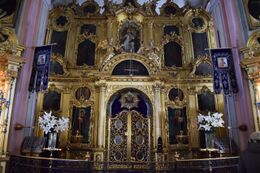
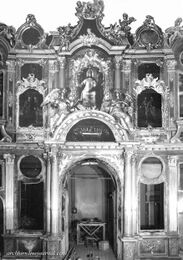
In their written memoirs, eyewitnesses describe the interior of the church as striking in its splendour. Sadly, little has survived to this day. In 1808 - 1810 an iconostasis from the Church of the Resurrection of Anichkov Palace was installed, replacing the original one. The design of the new iconostasis was based on the 1748 drawings of the famous architect Francesco Bartolomeo Rastrelli and is the only surviving example of an iconostasis of his design. Iconographers I.Vishnyakov, I.Belsky, A.Antropov painted its thirty icons, of which 24 have survived. Ranked among the top ten works of Russian church art, this iconostasis is one of the church's main attractions.
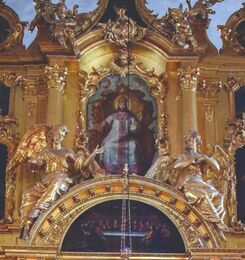
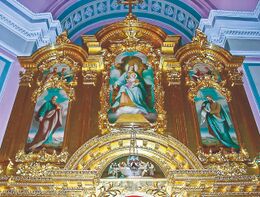
Four massive octagonal pylons divide the high hall of the upper church into three niches. The iconostases in the side niches are newer than the central iconostasis. They were completed in the mid-19th century in the Baroque style for the sake of uniformity.
The side niches were consecrated years later. The northern niche, in 1886, was dedicated to the Icon of the Mother of God "Joy of All Who Sorrow", and the Southern niche, in 1872, to the Holy Martyrs Faith, Hope, Love and their Mother Sophia. The eastern niche, at the centre, had been consecrated much earlier, at the completion of the church.
Among the parishioners of the Vladimirskaya Church, there were many celebrities of Russian culture. Writers Fyodor Dostoevsky, Alexander Kuprin, and Lev Gumilev, composer Nikolai Rimsky-Korsakov and many other great names of different times used to worship here. Pushkin's parents rented an apartment nearby, at Svechnoy Pereulok, House 5. Alexander Pushkin stayed at this address briefly in 1826 after returning from exile at his estate in Mikhaylovskoye Village. He attended the funeral services at this church for his nanny, Arina Rodionovna, and his childhood friend Anton Delvig.
Of all the great names with connections to this church, Dostoyevsky perhaps is the most prominent. Many know him by his novel "The Gambler", inspired in more ways than one by his addiction to roulette. The casino at Wiesbaden - where he played while staying at a spa resort in 1865 - still keeps the roulette table at which he made his bets and lost an entire fortune. Yet the main inspiration for his writing was not the roulette, but his faith and love of God. Dostoevsky grew up in a religious family which took the practice of their faith very seriously. Every year, his mother took him and her other children to Zagorsk to visit the Holy Trinity Sergius Lavra.
In his life, there were many churches. He married his wife, Anna Grigoryevna, at the Russian Imperial Army Izmaylovskiy Regiment Church in St. Petersburg. On 12 April 1877, he was on his way to a bank with his wife he heard from the newspaper sellers about the war with Turkey. Immediately, went to pray at the Kazan Cathedral. Grieving the loss of his three-year-old son Alex in June 1878, he travelled to the male monastery Optina Pustyn. Shortly before his return to St. Petersburg from exile, a monument to Nicholas I was erected near St. Isaac's Cathedral. During the reign of this Russian monarch, Dostoyevsky was sentenced to hard labour on a political charge. The Holy Trinity Church of the Alexander Nevsky Lavra was the last in Dostoyevsky's life. Here, the funeral service was held for him before he was buried at the Tikhvin Cemetery on February 1, 1881.
Yet the Church of the Vladimir Icon of the Mother of God stands out among all these other churches. He visited it more than others, especially in his last years. He saw it from the windows of his office in Kuznechny Lane. On Sundays and holidays, he came here with his family. He became a member of its parish towards the end of his life.
The people at the church and beggars on its porch recognised him by his pensive look and staggering gait. He always gave alms to those who asked. On the one hand, he viewed compassion as the highest form of human existence; on the other, he insisted that begging corrupts both the giver and the taker, undermining the purpose of the giving. He went to the same confessor who served at this church and received his last communion here. With the blessing of the Metropolitan of Saint Petersburg, the church has held annual memorial services for Dostoyevsky on the day of his departure, starting from 9 February 2020, the 139th anniversary of his death.
In 1930, the church was closed. The authorities had the gold removed from its domes and ordered them to be painted black. From 1932, the church building housed the storage facility of the Library of Atheistic Literature, a branch of the State Public Library. Some of its surrounding buildings were handed over to a construction company. After World War 2 - which the church had survived - it was again used as a library facility - this time, by the Academy of Sciences. Finally, it was given over to a clothing factory of the ministry for knitwear production.
In 1989, the church was returned to the Leningrad Diocese, six decades after its confiscation. The Russian scientist, historian and writer Lev Gumilev and academician Dmitry Likhachev, an honorary citizen of Leningrad, facilitated its return to the Russian Orthodox Church.
On the feast of the Annunciation in 1990, Metropolitan Alexey of Leningrad and Novgorod consecrated the church and became the first prior of its parish. A major renovation effort began.
On 7 May 2000, the Church of the Vladimir Icon received cathedral status. It has been added to the list of cultural heritage sites of federal significance protected by the state. The church has five domes with crosses, three narthexes and an apse. At its base, it has the shape of a square with truncated corners. It is an architectural landmark of Zagorodny prospect and Vladimirskaya square. With its yellow walls, domes and a bell tower, it fits naturally in the surrounding historical landscape and represents a model for church design in Saint Petersburg. It has also been proposed to design all new buildings in its vicinity in a way that maximises the Church's visual attractiveness and maintain continuity of the architectural styles.
In 2019, the restoration of the gilded domes and crosses - started in 2014 - was complete. The black paint that covered the domes in Soviet times was gone.
Renovation of the facade and the interior has also been finalised. At the time of this writing, the lower church iconostases were still being renovated. The plan is to rebuild them in the style of "Elizabethan" Baroque, with consideration for the motifs of the upper church iconostasis. As you may remember, its design was based on the drawings of the famous Francesco Bartolommeo Rastrelli.
For a long time, the date of the last restoration of the gilding on the domes remained unknown. An accident helped resolve the mystery. Several years ago, the church's staff were vacuum cleaning the floor when they discovered a shredded note in one of the iconostases. Written in pencil, it stated that in 1900 Alexey Pelevin - assisted by Fyodor Bogdanov and Ivan Kulakov - completed the gilding of the iconostasis. In his note, Pelevin also asked to be remembered at the church together with his helpers. His request has been fulfilled.
The main relics of the cathedral are the Vladimir Icon of the Mother of God, the Image of Edessa ("Savior Not Made by Hands"), and the icon of Seraphim of Sarov with a particle of his holy remains.
The Vladimir Icon of the Mother of God came from Byzantine at the beginning of the 12th century. In 1131, the Patriarch of Constantinople Luke Chrysoberges sent it as a gift to Yuri Dolgorukiy. According to tradition, the icon arrived in Constantinople from Jerusalem in the 5th century during the reign of Emperor Theodosius II. It is attributed to Luke the Evangelist, who put to canvas his vision of Mary, Joseph and Jesus as a child eating dinner. Mary was embracing the child as was looking towards her and reaching out for her. Yet there was sorrow on her face.
According to the Gospel, Luke was one of the seventy disciples whom the Savior had blessed to preach the word of God. Thirty years after his conversion, he became the closest associate of Apostle Paul and accompanied him on his journey to Rome. The surviving testimonies of the Christians of Rome, dating back to about 170, add to our knowledge about Luke the Evangelist. They portray him as a doctor with perfect knowledge of the law and a good painter. His multiple talents should not surprise us – education in ancient times was holistic and versatile (and also expensive). Presumably, he studied in Antioch, a major centre of arts and sciences of his days. Some scholars believe that Mary might have sat for her portraits herself.
The Vladimir Icon is not the only depiction of the Mother of God attributed to Luke's brush. Others include the icons of the Mother of God of Tikhvin, Jerusalem, Czestochowa, Korsun, Wilna, and Carmel, among others. Yet historians have dated most known images of the Mother of God, including the Vladimir Icon, to the 11th and 12th centuries. An overwhelming majority of professionals have accepted their estimate. Zhanna Belik, head of the department of expertise and art criticism of Russia's Andrey Rublev Museum, is one of them. She believes that the Vladimir Icon was painted sometime around the 12th century. Experts also agree that the Vladimir icon was most likely a copy from an earlier image. According to a medieval legend, Apostle Luke had made three depictions of the Mother of God during her lifetime under the guidance of archangel Gabriel. Scholars believe that these three images could be the icons of the Mother of God of Kikkos, Carmel, and Filerma. The first is found in the Kykkos Monastery in Cyprus. It arrived in the 11th century from Constantinople. Originating from Egypt, it came to Constantinople sometime in the 9th or 10th centuries. The Carmel icon also came from Egypt and travelled to Greece in c.a. the 4th century. The Filerma icon had been to Antioch, Jerusalem, the Holy Land, the islands of Crete, Rhodes and Candia, the cities of Messina, Naples, Nice and Rome before it finally reached La Valenta on the island of Malta. There, it was placed in the chapel of the Madonna of Filerma, its presumed place of origin. When the French captured Malta in 1798, the Maltese knights turned to Russia for protection and patronage. They brought the Filerma icon to Russia as a gift to the Russian Emperor Paul I. In 1919, General Yudenich of the White Guard claimed the icon as his spoils. On his retreat from Gatchina, he dispatched it to Europe via the Estonian city of Revel (Tartu). Many years later, the icon resurfaced in Yugoslavia, ending up in Cetin, Montenegro, where it became an exhibit of the National Museum, kept in its "Blue Chapel" section. The Filerma icon is a rare depiction of the Mother of God. In it, she is depicted without the baby Christ.
However, even these oldest icons date back to the 8th century, according to scientific estimates and expert opinion. They were all painted in the tempera technique (bonding natural pigments with egg yolk). The paints for the Early Christian icons were produced by mixing the pigments with hot wax. On their quest to trace the origins of the images, scientists turned to the so-called Fayum portraits, discovered by British archaeologists in 1887 in the Fayum oasis in Egypt. They were depictions of men and women in the finest detail as if they were alive. Strikingly, they were dated to the third century. Soon, ninety more portraits were discovered, with the oldest among them dated to the first century.
According to Archpriest Nikolay Sokolov of the Church of St. Nicholas in Tolmachi at the Tretyakov Gallery, icons did not exist in the early years of the Christian Church, and the faithful used portraits instead. Luke painted portraits, but that does not necessarily mean that the Vladimir Icon - or any of the other icons attributed to the evangelist - were somehow not genuine. Leonid Uspensky, a prominent scholar of iconography adds:
"The icons that tradition attributes to Luke are copies from the original images created by the evangelist. It is only a question of terminology: we do not refer to the apostolic rules or the apostolic order of the divine liturgy because the apostles wrote them. We call them apostolic because they keep the spirit and the authority of the apostles. Luke's images of the Mother of God attributed are genuine in this sense".
To the Orthodox faithful, Luke's depictions are authentic because their copiers had not simply replicated the graphics but also preserved the divine spark of the original. As a result, the copies have kept their miracle-working power.
As the legend holds it, the Vladimir icon acquired its name during the reign of Yuri Dolgoruky. The Mother of God appeared to him in his dream and commanded him to take the icon to the city of Vladimir and build a church for it. Some historical sources suggest that Prince Andrey Bogolubsky, a saint of the Russian Orthodox Church, brought it to Vladimir City in 1155. One way or another, the icon came to be called Vladimirskaya because of its location in Vladimir.
The church keeps a copy of the Vladimirskaya Icon. The original is found in the museum church of St. Nicholas in Tolmachi of the Tretyakov Gallery.
In its history, the icon has survived many disasters. One of the most devastating fires in Russia's medieval history destroyed the inner decor of the Assumption Church of Vladimir but did not affect the Vladimirskaya icon that was kept there. It survived intact the deadly invasion of Mongol-Tartar ruler Batu Khan.
In Russia, people have traditionally prayed before the Vladimir Icon of the Mother of God for Her intercession in resisting foreign invasion. According to legend, the Mongol Khan Tamerlane withdrew his armies from Russia after seeing a vision of the Mother of God.
On 6 July, Orthodox Christians commemorate Moscow's wonderous escape from devastation at the hands of Khan Akhmat in 1480. Russia, a vassal to the Mongol Khanate, had refused to pay tax to it. In response, Khan Akhmad brought his armies to punish the Russians. He stopped at the River Ugra. Opposite him on the other bank was the army of John III, the father of Ivan the Terrible. Neither party dared to cross the river to engage in a battle. Finally, the Mongols left. After this incident - known as the Great Standing on the Ugra - the river received the alternative name "Mary's belt" in memory of Her miraculous protection of Her people.
In December 1941, the Nazis were pushing towards Moscow and had almost reached its outskirts. At that critical moment, the Soviet leader Joseph Stalin was reported to have ordered to fly an icon of the Virgin Mary over Moscow in a Douglas place. It is still uncertain which icon it was, or whether it was flown at all. However, the Orthodox fiction writer Nikolay Blokhin insists that the reports are credible. Officially, the Tikhvin Icon of the Mother of God had been captured by the Nazis, while the Vladimir Icon had been evacuated to Novosibirsk along with the other exhibits of the Tretyakov Gallery. However, some insist that the Vladimir Icon was secretly left in Moscow to keep up the fighting spirit of Moscow's defenders. As a former student of an Orthodox seminary, Stalin appeared far more lenient to religion than many of his Communist Party comrades. He even went as far as to ban the production of an atheistic play by the Soviet author Demyan Bedny for its derogatory depiction of the baptism of Russia. Could it be that a leader whose name is associated with violence and repression agreed to call for the help of the Mother of God for the sake of his country and people? We leave this question to the judgment of the reader.
One way or another, Russian Orthodox believers trust in the power of the Mother of God to protect them from foreign invasions, times of trouble and other sorrows. They pray before the Vladimir Icon of the Mother of God and the Image of Edessa to have the strength to overcome their difficulties, diseases and predicaments.
The Russian Saint Seraphim of Sarov lived in the 18th century and was known for his righteousness, piety and miracle-working powers. His father was a successful businessman and a philanthropist, but Seraphim did follow in his footsteps. Instead, he dedicated himself to Orthodoxy from a young age. Christians appeal to Saint Seraphim of Sarov for his help in healing their ailments, restraining their passions, making good life choices, building strong families and finding success in their business endeavours.
Out of a total of six altars, the Vladimirskaya Church is now using two in its worship. The main altar is dedicated to the Vladimir Icon of the Mother of God (commemorated on 8 September, 3 June, and 6 July). The other altar bears the name of the Holy Martyrs Faith, Hope, Love and their mother Sophia (commemorated on 30 September). To view the schedule of its worship, please refer to the '''[http://vladimirsobor.spb.ru/ official website of the Vladimirskaya Church]'''.
The prior of the church, Metropolitan Vladimir (Kotlyarov) has served in this capacity since 1996. Nine members of the clergy are assisting him. The church runs a Sunday school, a school for bell ringers and a library, and offers free legal advice to the needy.
Whatever are your views on religion, the Church of the Vladimir Icon of the Mother of God is an exciting place to visit in Saint Petersburg. Be sure to add it to your sightseeing programme. Everyone is welcome!
* '''[[Престольный праздник:: Илия Фесвитянин, пророк]]''' - [https://azbyka.ru/days/sv-ilija-fesvitjanin (22 апреля (переходящая) – Собор Синайских преподобных; 2 августа)]
== Контакты ==
== Контакты ==
Строка 210:
Строка 124:
* [https://vk.com/vladimirskiy_sobor_spb Страница храма ВКонтакте]
* [https://vk.com/vladimirskiy_sobor_spb Страница храма ВКонтакте]
* [Telegram канал храма.]
* [https://vk.com/vladimirskiy_sobor_spb Telegram канал храма.]
* [Яндекс.Дзен храма.]
* [https://gorbilet.com/blog/interesnie-mesta/vladimirskij-sobor Владимирский собор — святыня, где молился Достоевский.]
* [https://globus.aquaviva.ru/places/?view=catalog&b=2165 Центральный округ. Храмы.]
* [https://globus.aquaviva.ru/places/?view=catalog&b=2165 Центральный округ. Храмы.]
* [http://globus.aquaviva.ru/sobor-vladimirskoy-ikony-bozhiey-materi-na-vladimirskoy-ploshchadi Собор Владимирской иконы Божией Матери на Владимирской площади. Общие сведения]
* [http://globus.aquaviva.ru/sobor-vladimirskoy-ikony-bozhiey-materi-na-vladimirskoy-ploshchadi Собор Владимирской иконы Божией Матери на Владимирской площади. Общие сведения.]
* []
* [https://peterburg.center/maps/sobor-vladimirskoy-ikony-bozhiey-materi Собор Владимирской иконы Божией Матери.]
* []
* [https://mitropolia.spb.ru/news/av/?id=18381 ВЛАДИМИРСКАЯ ЦЕРКОВЬ САНКТ-ПЕТЕРБУРГА ПОЛУЧИЛА СТАТУС СОБОРА.]
* []
* [https://mitropolia.spb.ru/news/parishs/?id=70745 Новый колокол "Владыка" поднят на звонницу Владимирского собора.]
* []
* [https://www.citywalls.ru/house689.html Владимирской иконы Божией Матери собор с колокольней.]
* []
* [https://peterburg.guide/sobory-i-hramy/vladimirskij/ Владимирский Собор в Санкт-Петербурге.]
Собор Владимирской иконы Божией Матери построен в 1761-1769 годах, расположен в самом центре Петербурга. От Владимирской церкви происходят наименования Владимирского проспекта и Владимирской площади. Храм принадлежит Санкт-Петербургской епархии Русской Православной Церкви, входит в Центральный благочиннический округ.
Собор в честь иконы Владимирской Богоматери один из старейших в городе на Неве. Построенный во второй трети XVIII века, он находится в самом центре, близ Невского проспекта на Владимирской площади.
Тогда граница Санкт-Петербурга проходила по реке Фонтанке. Въезд в город находился у моста на Невской «першпективе». Здесь были шлагбаум и застава, называемые Аничковыми. Эта местность носила название – Московское предместье.
В петровские времена строительство велось лишь вдоль «першпективной дороги» и Фонтанки – остальная территория долгое время пустовала. Постоянное поселение в Московском предместье возникло лишь в 1737 году. После опустошительных пожаров 11 августа 1736 и 24 июня 1737 года, когда тысячи людей оказались без крова, правительство императрицы Анны Иоанновны предприняло решительные меры для урегулирования городской застройки, обеспечения людей жильем и предотвращения новых пожаров. Высочайшим указом придворным служащим было выделено место для строительства собственных домов за Аничковой заставой.
Внутри слобод предусматривалось устроить площадь с церковью, но к постройке храма приступили лишь в 1745 году. Инициатива строительства принадлежала начальнику Придворных слобод (так стали именовать район, в который пересели придворных, конюшенных и дворцовых служителей), управляющему кабинетом ее императорского величества барону Ивану Антоновичу Черкасову.
Первая церковь была выстроена из дерева и имела один купол. 25 августа 1747 года преосвященный Феодосий (Янковский) совершил торжественное освящение храма в честь Владимирской иконы Божией Матери. На следующий день, 26 августа (8 сентября по новому стилю), в храмовый праздник Сретения Владимирской иконы Божией Матери, на литургии присутствовала императрица Елизавета Петровна, пожертвовавшая на благоустройство храма 300 рублей. Деревянная церковь с примыкавшей к ней с запада трехъярусной колокольней простояла в Придворных слободах 23 года.
В 1756 году прихожане подали прошение о строительстве нового каменного храма, так как старая церковь обветшала. Разрешение было получено. Священник Иоанн Кириков принялся за сбор пожертвований. К 1760 году была собрана достаточная сумма и был готов проект новой церкви. По мнению многих исследователей, автором проекта был Пьетро Антонио Трезини. Строительство каменного храма велось долго – 15 лет и завершилось в царствование императрицы Екатерины II.
8 ноября 1768 году архиепископом Санкт-Петербургским Гавриилом (Кременецким) был освящен нижний храм, а верхний 9 апреля 1783 года освятил митрополит Санкт-Петербургский и Новгородский Гавриил (Петров).
Настоятель храма священник Иоанн Кириков не дожил до этого события, в октябре 1770 года он был злодейски убит в собственном доме, расположенном вблизи церкви. Грабители, рассчитывавшие найти у него большие суммы, ведь на строительство храма жертвовали немалые деньги не только жители Петербурга, но и Москвы, обнаружили в доме у иерея лишь 40 копеек. Отец Иоанн был бессребреником.
Его погребли близ церкви. К 230-летию храма, в 1998 году, на его могиле был поставлен крест из белого мрамора и восстановлена плита с надписью: «Строитель Владимирской церкви священник Иоанн Кириков, убитый злодеями в ночь на 20-е число октября 1770 года». По традиции, при совершении крестного хода в престольные праздники на могиле совершается панихида.
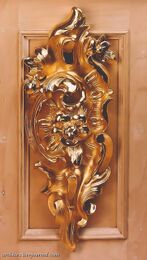
Внутреннее убранство каменного храма уже в первые годы его постройки поражало своим великолепием. До наших дней не сохранились ни иконы, ни утварь, ни богослужебные книги. Первоначальный, изготовленный для Владимирской церкви во времена Екатерины II иконостас, в 1809–1810 годы был повернут лицевой стороной к алтарю, а на его месте воздвигнут другой, переданный из церкви Воскресения словущего Аничкова дворца. Выполненный по рисунку Ф. Растрелли в 1748 году, это единственный дошедший до нас и сохранившийся почти полностью иконостас мастера. Иконы для него написали И. Я. Вишняков, И. И. Бельский, А. П. Антропов. Первоначально было 30 икон, но до наших дней уцелели 24. Золоченая резьба тоже имеет утраты.
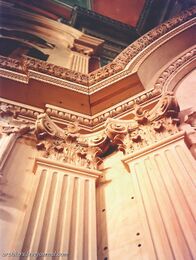
Пространство высокого зала верхней церкви разделено на три предела четырьмя массивными восьмигранными пилонами. Иконостасы в боковых пределах – поздние, середине XIX века, но они также выполнены в барочном стиле.
В 1886 году в честь иконы Богоматери «Всех скорбящих Радость» был освящен северный придел храма, а в 1872-м – южный во имя святых Веры, Надежды, Любови и матери их Софии.
Жизнь Владимирской церкви была связана с именами выдающихся деятелей русской культуры. Прихожанами храма были Федор Михайлович Достоевский, Николай Алексеевич Некрасов, Николай Андреевич Римский-Корсаков, Александр Иванович Куприн, Лев Николаевич Гумилев и многие другие.
В приходе храма жили многие известные деятели русской культуры. Недалеко от храма, на Свечном переулке в доме № 5, снимали квартиру родители А. С. Пушкина – Сергей Львович и Надежда Осиповна. По возвращении из Михайловского в 1826 году у них останавливался Александр Сергеевич. На ул. Марата (быв. Грязной) снимала квартиру семья Павлищевых. Николай Иванович Павлищев был мужем Ольги Львовны Пушкиной – сестры поэта. У них в доме последние свои месяцы прожила няня Александра Сергеевича – Арина Родионовна. Ее отпевали во Владимирской церкви. Здесь же отпели и друга поэта – Антона Антоновича Дельвига, проживавшего последние годы близ Владимирской площади.
Храм был закрыт в 1932 году и его помещения были отданы под книжные фонды Государственной Публичной Библиотеки для размещения в нем ее филиала — Антирелигиозной библиотеки, а затем еще и строительному тресту. После войны устоявший в блокаду храм вновь передали под хранилище книг Библиотеки Академии Наук, а в 1947 году Ленпромкомбинату Физкультпромснаба под трикотажное производство.
В августе 1989 года после 60-летнего отчуждения и запустения Собор Владимирской иконы Божией Матери решением Ленгорисполкома был передан ленинградской Епархии. Способствовали возвращению собора и видные светские петербуржцы – учёный, историк и писатель, русский патриот Л. Н. Гумилев и почетный гражданин Санкт-Петербурга Д. С. Лихачев, один из предков которого был старостой храма.
В настоящее время ведутся проектные и реставрационные работы по воссозданию иконостасов верхнего и нижнего храмов, а также украшению собора предметами церковного декоративно-прикладного искусства.
9.jpg)





_8.png)
_9.png)
_11.jpg)
_1.jpg)
_2.jpg)
_3.jpg)
_4.jpg)
_5.jpg)
_6.jpg)
_7.jpg)
_10.jpg)
_12.jpg)